
Food For Thought


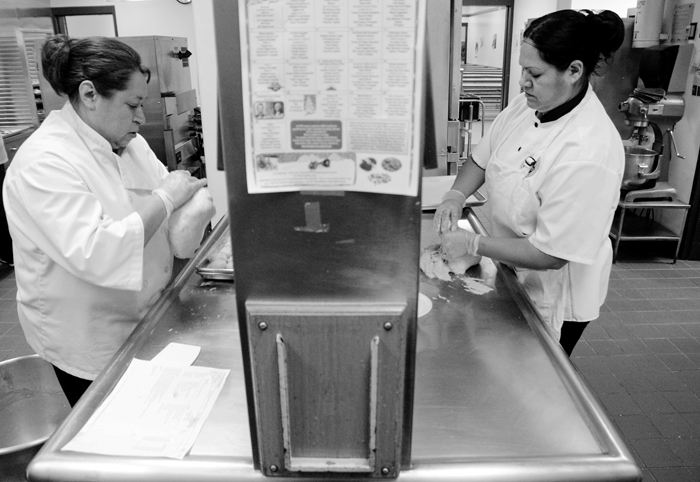
Cooks at Centennial Elementary prepare dough for oatmeal honey rolls they serve at lunch.

By Kristin Pazulski

Photography by Adrian DiUbaldo

Leo Lesh’s food service enterprise includes 156 locations and serves about 38,700 lunches per day. He’s not open on the weekends, charges just $1.40 per meal (if customers pay full price, though many do not) and he gets just $2.72 per meal beyond that charge to cover all his food, labor and operations costs.

Most would say it’s an impossible feat. A dying business, one that won’t make it, but this is no ordinary food service business. And Lesh, executive director of Denver Public Schools Food and Nutrition Services, has not only managed to keep DPS’s school lunch program chugging along, he’s slowly improving the nutritional side of a traditionally unhealthy meal.

And just in time too. While Lesh has been looking for ways to reduce sodium in cheese and fat in milk, the U.S. Department of Agriculture has been developing guidelines that will require him to do just that.

Read More
Tough Love

By Tom deMers


Home was the third floor of a house with a balcony out front. It was the top floor a few blocks from one of Denver’s busiest streets. It was secure. Three locked doors separated the apartment from the street below. But it wasn’t safe. Renee had keys to none of those doors. She was allowed out once a week when they went to Wal-Mart. She wore oversized sunglasses to hide the bruises and always walked behind him. He pointed to things, she put them in the cart. If the damage to her face wasn’t too bad, they stopped for lunch. He sat between her and the exit.


Read More
Campaign Questions

By Tim Covi

With the Mayoral elections around the corner, we wanted to ask candidates for their opinions on an often under-discussed topic in municipal elections: homelessness. Over the past few years, Denver’s homeless population has sky rocketed, going from 3,954 people in 2007 to 6,656 in 2009, a 68 percent increase. Service providers estimate that it has continued to rise through 2010, something we won’t know clearly until the next Point in Time survey is released later this year.

While not completely solving the problem, Denver’s Road Home—the city’s 10-year plan to end homelessness—has been instrumental in creating more housing opportunities and bringing much needed attention and resources to the homeless community. Mayor Hickenlooper was a pivotal part of garnering support and funding for the plan.

We asked every candidate two questions to see how they’ll approach the issue of homelessness. Twelve of the 14 candidates answered by press time. Additional responses might become available on our website at: www.denvervoice.org

Read More
Meet Metech

A worker at Metech breaks down electronics into recyclable parts for further processingBy Patrick Naylis

Photography by Ross Evertson

Semi-trucks dominate the traffic in this part of Denver’s industrialized north side.  Inside a dusty100,000 square foot warehouse, a line of around 20 workers disassembles electronic goods.  They demolish electronic products ranging from 50’s era bakelite TV consoles to modern day hi-res flat screen monitors.  Behind them, hi-los scoot across the concrete floor carrying bins of sorted electronic components to waiting semi-trailers. 

This is Metech Recycling, an e-waste recycler that differs from other recyclers in the area.  Conscientious consumers brought their electronic refuse to Metech because they know it will be recycled responsibly.  They are certain it won’t be discarded in a municipal landfill or dumped on a poor nation in, say, West Africa, causing polluted air, aquifers, and soil.

Metech provides this guarantee as the basis of their business, and with the growth in disposable commodities causing environmental concern, it’s an important guarantee.

Americans buy a lot of new technology.  According to the Consumer Electronics Association, we spent $180 billion on electronic gadgets last year.  They seem to make our lives easier, save time, and offer more ways to communicate.  Consequently, Americans also trash a lot of technology: according to the Environmental Protection Agency (EPA), we produced 3.1 million tons of e-waste in 2008.

Read More
Mulling Over the Mall

By Kristin Pazulski

Photography by Adrian DiUbaldo

Another group of casually dressed business people runs by you, trying to catch the bus, talking about the latest speaker and wearing lanyard tags naming the convention they are attending at the Hyatt.

You look down at your jeans and sweater, and wonder if you’re supposed to be wearing a suit to be on the 16th Street Mall, because that’s all you can see. But no, it’s just that Denver’s downtown is different. With fewer people living in Denver than working and visiting, the downtown area’s one dominating street, the 16th Street Mall, sees more traffic from the more than 100,000 office workers and 2.1 million annual visitors than it sees from Denver residents.

Not only that, but walk a block off of 16th Street and the story is much different.

Downtown Denver is dominated by a 15-block strip of stores, restaurants and vendors that attract most of the area’s pedestrian traffic. The Mall Ride is beeping, bags are rustling, conversations float from cafes and the street furniture as people take a rest from shopping or walking. But the adjoining streets are quiet. There are shops and restaurants—plenty of shops, some which have been there for years. But the bustle is missing. Cars whizz by in four lanes of one-way traffic. The white-walking-man lights go on, but only a few people saunter across the street—most on their way to a hotel, a bus stop or the Mall.

Those side streets could be the future of Denver’s downtown development, but having oriented the city around one street, what will it take to build a more balanced city-center—one with shopping, entertainment, residences and pedestrian areas throughout?

Read More
Banking on Prosperity

Debra and Clarence sit on the stoop of the home they are temporarily living inBy Kristin Pazulski

Photography by Adrian DiUbaldo


When Debra and Clarence Rhames laid their blankets down on the back patio of the King M. Trimble building in Curtis Park, little did they know the help they sought was just on the other side of the wall they were leaning against.

In late summer, the couple arrived in Denver on a Greyhound bus from Florida. With little money, but high hopes for Clarence landing work at a labor pool, they decided to stay on the streets when they first arrived in the Mile High city. They did not expect to still be without home and job at Christmas.

“I’ve never been through being homeless before until now, and I’m telling you now it’s not a good feeling. … I’m not a patient man,” said Clarence, who despite spending hours at the nearby labor pool has barely found a day’s worth of work. Fortunately, the couple chose the right place to “camp out” when they stopped at 30th and Champa Streets.

The King M. Trimble building, where they laid down their blankets that September night, houses the Economic Prosperity Center, a relatively new resource for Denver residents seeking financial and career help. EPC brings together five organizations, the Mile High United Way,  the Office of Economic Development (OED), the Denver Housing Authority, the Denver Asset Building Coalition and the Rocky Mountain MicroFinance Institute to offer free financial education classes, career boosting lessons, skills assessment, tax services, college preparation courses, small business coaching and computer classes.

“We want to be a central hub, like a resource center for people,” said Danelle Herman, the marketing coordinator for EPC. “So it’s like a one-stop-shop.”

Read More
Dry Docked: The New Life of Venice and Grand Isle, Louisiana

A local man involved in cleanup.Photography and Text by Zoriah Miller

As a photojournalist, I learn something new from each and every project I do. Sometimes I come away from a story with profound new facts, information that I never could have discovered had I not just gone and experienced it myself. Sometimes what I learn is life changing, knowledge that opens my eyes and allows me to see the world and humanity in a completely new light.

Other times I feel like I learn very little, and in some cases I feel like I know less about a situation than I thought I did going into it. This was my experience shooting the aftermath of one of the worst oil spills in history, the BP Gulf Oil Spill.

Going into the project, I pictured angry fishermen protesting on the streets, fighting for a livelihood that had been passed down from generation to generation. I pictured oil-drenched beaches with dead animals strewn about and thick sludge as far as the eye could see. I pictured eye-opening conversations with scientists and wildlife officials. But what I actually found when I arrived was, for the most part, quite different.

Read More
Forget the Bootstraps, Part III: Invisible Punishment

A painting crew, part of the Safer Return initiative, painting viaducts along train lines in ChicagoBy Margo Pierce

Photography Provided by Safer Foundation

Prison isn’t just a punishment —it’s a place apart with its own culture and rules. The experience of prison changes not only the inmate, but the families, friends and the community from which the convicted individuals come. More than 80 percent of inmates leave prison, and yet almost no preparation is done by anyone in any of these groups to support successful reentry.

The Safer Foundation in Chicago, Illinois, helps inmates navigate the barriers to re-entry, according to B. Diane Williams, executive director.

Read More
Hickenlooper on Homelessness


Mayor John Hickenlooper discusses Denver's 10-year plan

By Tim Covi

Photography by Ross Evertson

From an English major in undergrad, to a master’s student in Geology, from a young entrepreneur in a derelict part of 1980’s Denver, to the Mayor’s office, John Hickenlooper’s path to politics has been anything but direct. In office, he has led this city through huge changes and growth. He’s pushed for greater accountability in sustainable development, in green house gas emissions, and in police department reforms.

As he embarks on the Governor’s race, we sat down with him to discuss one of the defining aspects of his tenure in the Mayor’s office, Denver’s Road Home, our 10-year plan to end homelessness. 

Five years into this plan, Denver’s Road Home has accomplished several of its numeric goals in terms of providing services, though the homeless population has grown. Though well short of ending homelessness among either chronic or temporary populations, DRH has managed to bring more than 1,500 housing units online for the homeless, and has made homelessness a central aspect of community action in Denver. 

The recession triggered a spike in Denver’s homeless population, which grew from 2,628 in 2005 to 6,659 in 2009, or almost a 61 percent increase. Much more needs to be done to solve the problem. Without the centralized services created by DRH, the coordination of faith based efforts to support the homeless and the infusion of money generated by DRH, this population will balloon more. 

Mr. Hickenlooper talks to us about how DRH started, what motivated him to throw his weight behind it, where we need to go from here, and how successful aspects of DRH could be applied across the state.


Read More
Living City Block


Llewellyn Wells stands next to solar panels on the roof of the Alliance Center downtown

By Kristin Pazulski

Photography by Adrian DiUbaldo

Green. Sustainability. Collaboration. The first two are buzzwords we are familiar with in today’s new developments, but collaboration? That is something Living City Block is bringing to the table.

Living City Block (LCB) is taking the goal of sustainability a bit further, by attempting to convert existing buildings with various owners into a fully sustainable community.

LCB is focusing on creating this energy producing community on just one block in Denver (specifically the square block between 15th and 16th Streets and Wynkoop to Blake Streets in Lower Downtown). Its goal is to retrofit this block, so that by 2014 the buildings and businesses on the block will be creating their own energy with no waste, and two years later will be creating more energy than they use.

Read More