
 A local man involved in cleanup.Photography and Text by Zoriah Miller
As a photojournalist, I learn something new from each and every project I do. Sometimes I come away from a story with profound new facts, information that I never could have discovered had I not just gone and experienced it myself. Sometimes what I learn is life changing, knowledge that opens my eyes and allows me to see the world and humanity in a completely new light.
Other times I feel like I learn very little, and in some cases I feel like I know less about a situation than I thought I did going into it. This was my experience shooting the aftermath of one of the worst oil spills in history, the BP Gulf Oil Spill.
Going into the project, I pictured angry fishermen protesting on the streets, fighting for a livelihood that had been passed down from generation to generation. I pictured oil-drenched beaches with dead animals strewn about and thick sludge as far as the eye could see. I pictured eye-opening conversations with scientists and wildlife officials. But what I actually found when I arrived was, for the most part, quite different.
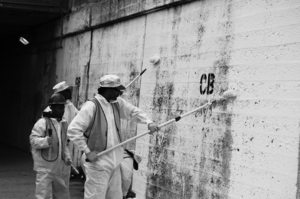 A painting crew, part of the Safer Return initiative, painting viaducts along train lines in ChicagoBy Margo Pierce
Photography Provided by Safer Foundation
Prison isn’t just a punishment —it’s a place apart with its own culture and rules. The experience of prison changes not only the inmate, but the families, friends and the community from which the convicted individuals come. More than 80 percent of inmates leave prison, and yet almost no preparation is done by anyone in any of these groups to support successful reentry.
The Safer Foundation in Chicago, Illinois, helps inmates navigate the barriers to re-entry, according to B. Diane Williams, executive director.
 Mayor John Hickenlooper discusses Denver's 10-year plan
By Tim Covi
Photography by Ross Evertson
From an English major in undergrad, to a master’s student in Geology, from a young entrepreneur in a derelict part of 1980’s Denver, to the Mayor’s office, John Hickenlooper’s path to politics has been anything but direct. In office, he has led this city through huge changes and growth. He’s pushed for greater accountability in sustainable development, in green house gas emissions, and in police department reforms.
As he embarks on the Governor’s race, we sat down with him to discuss one of the defining aspects of his tenure in the Mayor’s office, Denver’s Road Home, our 10-year plan to end homelessness.
Five years into this plan, Denver’s Road Home has accomplished several of its numeric goals in terms of providing services, though the homeless population has grown. Though well short of ending homelessness among either chronic or temporary populations, DRH has managed to bring more than 1,500 housing units online for the homeless, and has made homelessness a central aspect of community action in Denver.
The recession triggered a spike in Denver’s homeless population, which grew from 2,628 in 2005 to 6,659 in 2009, or almost a 61 percent increase. Much more needs to be done to solve the problem. Without the centralized services created by DRH, the coordination of faith based efforts to support the homeless and the infusion of money generated by DRH, this population will balloon more.
Mr. Hickenlooper talks to us about how DRH started, what motivated him to throw his weight behind it, where we need to go from here, and how successful aspects of DRH could be applied across the state.
 Llewellyn Wells stands next to solar panels on the roof of the Alliance Center downtown
By Kristin Pazulski
Photography by Adrian DiUbaldo
Green. Sustainability. Collaboration. The first two are buzzwords we are familiar with in today’s new developments, but collaboration? That is something Living City Block is bringing to the table.
Living City Block (LCB) is taking the goal of sustainability a bit further, by attempting to convert existing buildings with various owners into a fully sustainable community.
LCB is focusing on creating this energy producing community on just one block in Denver (specifically the square block between 15th and 16th Streets and Wynkoop to Blake Streets in Lower Downtown). Its goal is to retrofit this block, so that by 2014 the buildings and businesses on the block will be creating their own energy with no waste, and two years later will be creating more energy than they use.
By Travis Egedy
 It seems there may be something of a feminist (feminine?) revolution bubbling under the surface of Denver’s artistic communities. In last month’s VOICE, I wrote about the no holds barred Titwrench music festival, a local festival of progressive female music and culture that is run and operated by a group of strong, independent women. The festival is an all-inclusive look into contemporary feminist culture and the sounds that go along with it.
As it turns out, this creative energy by groups of women is not just limited to the underground music community, and I was compelled to write about some women who are making similar strides in the underground visual art scene in Denver. These women are a loose collective that call themselves “Pink Collar Glam,” taking their name from the “Pink Collar Army,” who were a group of working class women responding to the idea of “glamour” in the 18th century.