
Published March 2010 Vol. 14 Issue 3
by Tim Covi
Since the beginning of 2009 a new term, the cul-de-sac commune, has created an almost monthly buzz in Internet chat rooms, newsrooms and forums. Even without investigating much further, it’s easy to see why. It’s a combination of dipolar things. The cul-de-sac is the quiet compound of the suburban soccer mom. You think of easy Sunday mornings where the only sounds are a few finches and the gurgled zip of a freshly oiled bike chain as a neighborhood kid peddles by.
The commune, by contrast, is the cluster of stilted structures slapped up like a Tim Burton daydream on a remote desert horizon. It’s full of poorly washed hippies with radical ideas about free love, or at the very least, visions of utopia.
But for Stephanie Smith, the ideas of a commune and a suburban cul-de-sac don’t have to be at odds. They can even be right at home together in a Denver suburb.
Published March 2010 Vol. 14 Issue 3
text by Tim Covi
photots by Zoriah Miller

When it comes to growth and design, Denver seems to be at the cutting edge of new models of development, embracing terms of the times like “new urbanism,” “sustainable” and “green.” Communities like Lowry, Landmark, Stapleton and Belmar have spotted the landscape on the outer ring of the city over the past 8 years, and newer re-developments like the Gates Rubber Plant project and the planned build out behind Union Station are under way within the shadow of downtown.
Published March 2010 Vol. 14 Issue 3
Will Denver Have its own Harlem Renaissance?
written by Tim Covi
reporting by Dwayne Pride
photography by Adrian Diubaldo
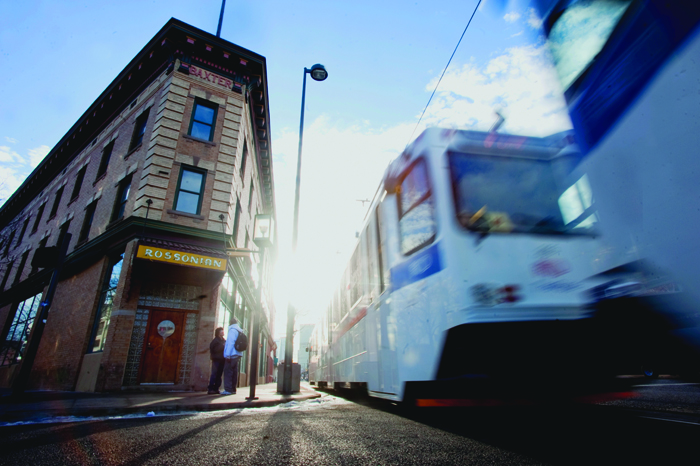
Standing at the corner of Welton and Washington Streets, if you look hard enough you might still see throngs of people coiling around the sides of the Rossonian Hotel. Young men standing under tipped fedoras and women in cocktail dresses and heels lined up to hear some of the best jazz the country has to offer. You’d have to look hard, mind you. Past the dusty, lightly sootsoiled brick, past the 1993 renovations, around the light rail that sidles up to the hotel’s flank and comes to a slow, furtive stop at the traffic light before rushing off down Welton with its payload. You’d need to look beyond the empty shell being remodeled, well into history. Because for several years, this corner has been a husk of what it was.
Publighed February 2010 Vol. 14 Issue 2
by Travis Egedy

Clark Richert is a lot of things to a lot of people. He is a Colorado institution who for the last 40+ years has been working as an artist, a scientist, a philosopher, a professor; and maybe most importantly, he’s an individual challenging his surroundings and the people who surround him to look deeper into what the universe really is, and how it works.
Published February 2009 Vol. 13 Isuue 1
by Tom deMers
Before this story begins, Paco was leading the ordinary life of a double agent. By day he sold credit card processing systems for MasterCard. Completely legit. By night he called law enforcement officials with information on consumer fraud. “I felt like Clark Kent,” Paco told me, “earning a living in my business suit and informing on these mafia types in my Superman role.” His undercover work prevented the financial abuse of working people and seniors, and Paco was proud of it.
But when the evidence he gathered on one Ponzi scheme was filed in Denver district court, his life became a nightmare. The filings were public record, and the thugs he informed on came after him. The death threats made him quit his job and drop out of sight. They phoned his mother in another state and harassed her for his whereabouts. Paco said the stress was unbearable. He moved out of Denver and into hiding at the home of a friend. After 18 months that situation became untenable, so Paco moved into his truck and hit the road.
Published January 2010 Vol. 14 Issue 1
by Travis Egedy
In this digital age of hypermedia and endless consumption of temporary, throw-away culture, Drippy Bone Books are a breath of fresh air. Drippy Bone Books is first and foremost a publisher of underground zines, handmade Xeroxed art objects that carry their signature style of pop culture collage and child like drawings. Each copy is a thing of personal touch, love and care, a touch that is becoming increasingly foreign in mass-produced culture. Started by local Denver artists Kristy Foom and Mario Zoots, Drippy Bone is now based out of Amsterdam and Los Angeles as well, allowing a large mass of zine fans and appreciators to rabidly snatch up everything this extremely creative collective spits out. With zine titles such as “Whore Eyes,” “Sonic Bonk,” and “Bronze Legs” the collective have a playful approach to what they do, never taking themselves too seriously. I spoke with Mario Zoots and Kristy Foom about building community through art, what it’s like to be making your own books just for the love of doing it.
