
Published January 2010 Vol. 14 Issue 1
Colorado Springs non-profits find alternatives to prison for juvenile offenders.
by Chris Bolte
Robert ran away from home at age 17, dropped out of school and couch surfed throughout the Colorado Springs area for four months. He was reluctant to talk about what, exactly, he did, so left it at he “got into trouble” and found himself in a treatment program through the Division of Youth Corrections. Through this program he was able to attain his GED and get started on a new path.
His circumstances are not at all uncommon. Dropping out of school has ramifications for young adults; idle time, isolation and even being cut off from many services provided for those still attending school. It can be a recipe for bad decisions.
Minor charges specific to youth are things like truancy or running away from home, gateway crimes. Some youth continue on this track to more serious crimes. They can be sent to the Division of Youth Corrections or, even worse, adult prison.
From there, if a youth returns to the same peers upon release, the same temptations to commit crimes and return to the system all over again are all but inevitable. This is what we have come to know as the recidivism problem.
Published December 2009 Vol. 13 Issue 11
text and images by D. Giles Clasen
For a Minnesota country-man, coming to Colorado meant becoming homeless, and inching ominously closer to the city every day.
Terri Schweppe does not belong in a city. His handlebar mustache, black cowboy hat and duster expresses clearly that he is a man more comfortable in a small town than downtown.
When he moved to Denver, it was a move full of both tragedy and hope. He drove his unreliable van from Minneapolis, across the barren cornfields of the Midwest, to Colorado’s Front Range expecting to find open air and a job.
But Schweppe didn’t find the sanctuary he expected. Instead, he quickly became homeless.
It is one more setback for Schweppe, who moved after his identical twin, Larry Schweppe, died of a stroke in April. “I have been a little lost without him,” Schweppe admits. “He was my compass. I sometimes feel like when he died I lost my identity. Now I have lost everything.”
The two had been roommates and best friends. Schweppe continues to carry Larry’s birth and death certificates. He handles them gently and with great reverence when he shows them. He pulls out his brother’s Minnesota driver’s license.
 "I only know how to do two things. I know how to work with the dirt and I now how to cook. I work hard and I’m honest. Those qualities don’t amount to much when you are trying to get a job.” — Terri Schweppe
Published December 2009 Vol. 13 Issue 11
by Dwayne Pride
Undeterred by the loss of a job, Oregonian Aaron Heideman turns his van into a home to canvas America.
Artprize is a national contest for fine artists and emerging artists from all around the world. It is said to be one of the largest prizes that an artist can hope to win to get recognized for his or her craft. All of the winners are chosen by the public. The top prize is $250,000. For most, when they think of somebody that would be part of a contest like this they would not think of a poor man, a homeless man, as one of its participants. Artist/ driver Aaron Heideman aka “The Man in the Van” proves this theory wrong.
“I don’t want to panhandle,” reiterates Aaron Heideman.
After losing jobs during the recession his life was more than just a struggle. He hit rock bottom. But he took a creative angle on his situation and found some freedom from a 9 to 5 with a road trip that would eventually take him through at least 30 States in America. His mission: to make an enormous tapestry of people’s experience of the recession. State by state, city by city, he collected words.
His project started out in Medford, which he calls home. Driving through places like Portland, Fresno, Las Vegas, Phoenix and Denver, he met all types of people and had them share their experiences from a sagging economy and what it has done to their lives.
People wrote their individual stories on rolls of 50-foot waterproof, tear-proof white tyvek paper. All he asked them was, “How has the recession affected you?”
“There is No Recession”

Published December 2009 Vol. 13 Issue 11
interview by Travis Egedy
Twenty-three-year-old Sterling Crispin is one of Denver’s most unique and exciting up and coming artists. Primarily working in video and digitally manipulated photography, his work explores many ideas on society’s current entanglement with technology and where we are headed as both biological and artificial organisms in the future. A graduate of Rocky Mountain College of Art and Design fine arts department, and a current artist in residence at Redline Studios, Crispin is part of a loose-knit group of radical young artists who are interested in pushing the Denver art community forward into a new era. These young artists are part of a new avant-garde for the recession generation, working with found materials, holding art shows in converted warehouses and critiquing the status of art in both Denver and the world. I was able to sit down with Sterling to eat some burritos, pet a cat and discuss the inevitable fusion of man and machine.

Published November 2009 Vol. 13 Issue 10
by William Hillyard
photos by Guillermo Arias
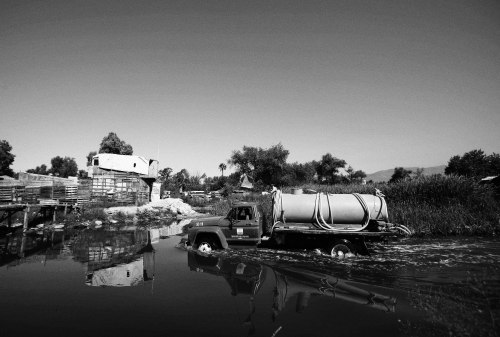 Tanker truck delivers water in Tijuana neighborhood
At low tide, you could walk to Mexico, around the crusty palisade of the border fence, without even getting your shoes wet. The thinnest can slip between the stakes, as kids do, dashing into America—‘look at me, mom!’—and slipping back again over the line. The Pacific’s relentless waves and salt spray have long ago eaten the fence’s metallic flesh, leaving a disheveled skeleton of rusty spikes, 12 feet tall, like the broken and bent teeth of a giant scaly comb. Dogs wander back and forth, around the pickets of steel—sections of railroad track actually, driven endwise into the sand—and sniff the cluttered beach, crossing the invisible line, the abstraction of the international border.