
Published November 2009 Vol. 13 Issue 10
by William Hillyard
photos by Guillermo Arias
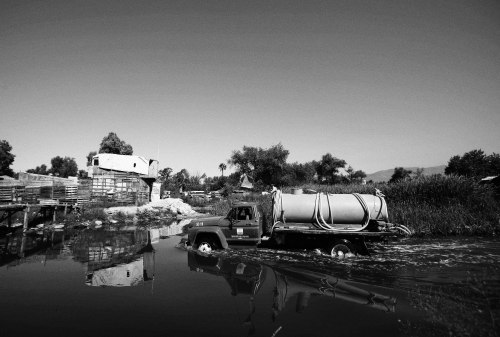 Tanker truck delivers water in Tijuana neighborhood
At low tide, you could walk to Mexico, around the crusty palisade of the border fence, without even getting your shoes wet. The thinnest can slip between the stakes, as kids do, dashing into America—‘look at me, mom!’—and slipping back again over the line. The Pacific’s relentless waves and salt spray have long ago eaten the fence’s metallic flesh, leaving a disheveled skeleton of rusty spikes, 12 feet tall, like the broken and bent teeth of a giant scaly comb. Dogs wander back and forth, around the pickets of steel—sections of railroad track actually, driven endwise into the sand—and sniff the cluttered beach, crossing the invisible line, the abstraction of the international border.
Published November 2009 Vol. 13 Issue 10
text by Ross Evertson and photos by Ross Evertson and Davin Risk
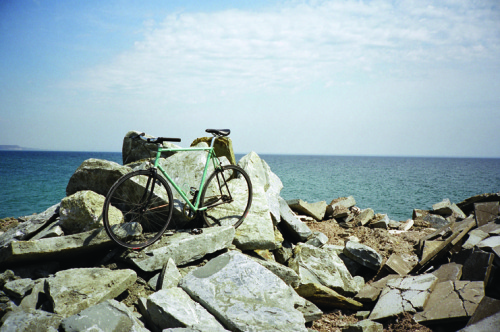
In any city it is incredibly easy to take for granted—or be ignorant entirely—of the things that are happening beneath us. Transportation and sewer systems, fault lines and lagoons—modern, ancient and natural catacombs of all sorts functioning and hiding below our cities.
Published November 2009 Vol. 13 Issue 10
text and photos by D. Giles Clasen
 Women working at Cafe Options
The word non-profit rarely carries thoughts of pizzazz. When the word is combined with restaurant, our minds may drift to something more akin to a soup kitchen than a fine cafe. But Cafe Options is a delicatessen downtown that has managed to combine non-profit with fine-food.
The restaurant, located at 1650 Curtis St., is a place where customers receive smoked meats, pickles and mustard all prepared from scratch. They give downtown diners a different option than many of the chain eateries along the 16th Street Mall. It also provides the opportunity for a small staff of low-income women to develop precious job experience as well as job skills as prep cooks.
Published November 2009 Vol. 13 Issue 10
by Margo Pierce
photos by Adrian Diubaldo
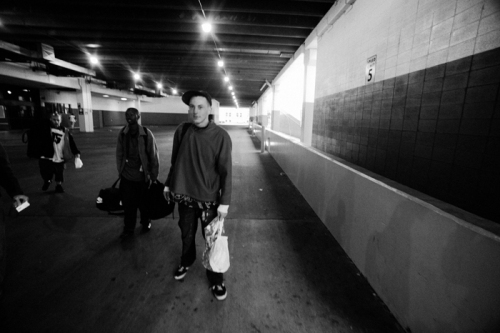
Some of the 27 million people worldwide who are bought, traded or are unwitting victims of human trafficking live and work in Colorado. It could be the person in the fields you drive past or on your doorstep telling you about a magazine offer. It’s not clear if Jose Garcia was a victim of human trafficking. He had one of those jobs that operates in a grey area. But one thing is certain: he is one of the lucky ones who was able to escape that possibility.
Published November 2009 Vol. 13 Issue 10
by Sarah Eckhoff
photo by Adrian Diubaldo
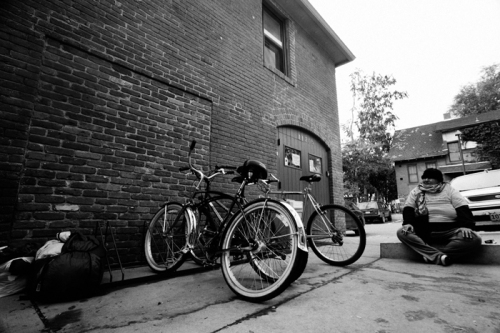 A woman rests outside the Carriage House in Boulder.
Jon Garrett carries his home on his shoulders. Every night he hopes to find a place where he can lay his head away from biting wind or cold rain. And at least four times in his almost two-year stint of homelessness, he has been wakened by law enforcement ready to convict him for this illegal activity.
Boulder Revised Code 5-6-10, Camping or lodging on property without consent, states that “no person shall camp within any park, parkway, recreation area, open space, or other public property” without first obtaining permission from the owner, supervisory officer or city manager. This means that from sunset to one hour after sunrise, any person carrying out “daily activities” such as eating, sleeping or seeking protection from the elements in a way other than clothing can be arrested.