Feature: Where is 'Away'?

Published November 2009 Vol. 13 Issue 10

by William Hillyard

photos by Guillermo Arias

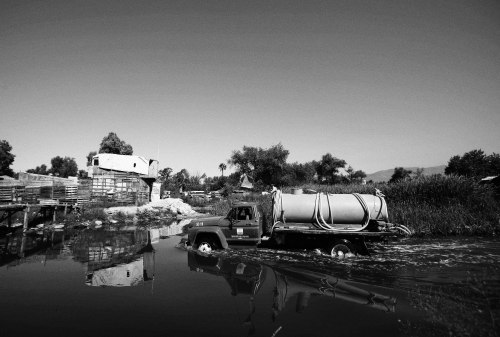
Tanker truck delivers water in Tijuana neighborhood

At low tide, you could walk to Mexico, around the crusty palisade of the border fence, without even getting your shoes wet.  The thinnest can slip between the stakes, as kids do, dashing into America—‘look at me, mom!’—and slipping back again over the line.  The Pacific’s relentless waves and salt spray have long ago eaten the fence’s metallic flesh, leaving a disheveled skeleton of rusty spikes, 12 feet tall, like the broken and bent teeth of a giant scaly comb.  Dogs wander back and forth, around the pickets of steel—sections of railroad track actually, driven endwise into the sand—and sniff the cluttered beach, crossing the invisible line, the abstraction of the international border.  

Read More
Art Feature: The Leslie Spit

Published November 2009 Vol. 13 Issue 10

text by Ross Evertson and photos by Ross Evertson and Davin Risk


In any city it is incredibly easy to take for granted—or be ignorant entirely—of the things that are happening beneath us. Transportation and sewer systems, fault lines and lagoons—modern, ancient and natural catacombs of all sorts functioning and hiding below our cities.

Read More
Profile: Cafe Options: A new way to bake a living.

Published November 2009 Vol. 13 Issue 10

text and photos by D. Giles Clasen

Women working at Cafe Options

The word non-profit rarely carries thoughts of pizzazz.  When the word is combined with restaurant, our minds may drift to something more akin to a soup kitchen than a fine cafe. But Cafe Options is a delicatessen downtown that has managed to combine non-profit with fine-food.

The restaurant, located at 1650 Curtis St., is a place where customers receive smoked meats, pickles and mustard all prepared from scratch. They give downtown diners a different option than many of the chain eateries along the 16th Street Mall.  It also provides the opportunity for a small staff of low-income women to develop precious job experience as well as job skills as prep cooks.

Read More
Freature: Magazine Crew - Human trafficking may have knocked at your door.

Published November 2009 Vol. 13 Issue 10

by Margo Pierce
photos by Adrian Diubaldo

 Some of the 27 million people worldwide who are bought, traded or are unwitting victims of human trafficking live and work in Colorado. It could be the person in the fields you drive past or on your doorstep telling you about a magazine offer. It’s not clear if Jose Garcia was a victim of human trafficking. He had one of those jobs that operates in a grey area. But one thing is certain: he is one of the lucky ones who was able to escape that possibility.

Read More
News Briefs: No Camping: Rough Sleepers Get the Boot From Boulder

Published November 2009 Vol. 13 Issue 10

by Sarah Eckhoff

photo by Adrian Diubaldo

A woman rests outside the Carriage House in Boulder.

Jon Garrett carries his home on his shoulders. Every night he hopes to find a place where he can lay his head away from biting wind or cold rain. And at least four times in his almost two-year stint of homelessness, he has been wakened by law enforcement ready to convict him for this illegal activity.

Boulder Revised Code 5-6-10, Camping or lodging on property without consent, states that “no person shall camp within any park, parkway, recreation area, open space, or other public property” without first obtaining permission from the owner, supervisory officer or city manager. This means that from sunset to one hour after sunrise, any person carrying out “daily activities” such as eating, sleeping or seeking protection from the elements in a way other than clothing can be arrested.

Read More
Beyond Denver: Turning Junk Mail into Art

Published November 2009 Vol. 13 Issue 10

by Alecia D. McKenzie

PARIS, France - Like everyone else, Barbara Hashimoto hated the junk mail coming in through the door. Until she decided one day that it could be transformed into art and lessons about the environment.
Hashimoto, a U.S.-born, Japanese-trained artist, has created “The Junk Mail Experiment,” in which huge quantities of unsolicited advertising mail are shredded into temporary installation art and eventually into sculptures. The “Experiment” is currently on view in Paris and in Chicago.

“I was working in a firm and was amazed at how much junk mail we received,” says Hashimoto, a slim dark-haired woman who speaks passionately about her work.

Read More
Personal Profile: Laying Tracks with Jack McConaha

Published October 2009 Vol. 13 Issue 9

by William Hillyard

Jack McConaha answered my knock in a white t-shirt.  “Come on in; have a seat,” he said.  “Say hello to the kids.”  

His ‘kids,’ two toy poodles, yipped at me from the side of the king-size bed that practically fills the windowless living room of his sprawling Wonder Valley cabin.  The dogs’ bed and food and water bowls sat in the rumpled covers.  The whoosh of the swamp coolers covered the room with a blanket of white noise, reducing the TV at the foot of the bed to a murmur.  

Jack disappeared to finish dressing.  “Must have picked up a nail,” he shouted from deep within the warren of the house.  “I checked the air in my tires this morning and one was a little low.”  It seemed he was continuing a conversation that had begun before I arrived.   “Don’t matter,” he went on, “it’s just down a couple of pounds.”  

Chatting constantly, he told me he doesn’t like the Firestone tires that came on his new patrol Jeep.  He’s going to replace them, he said; get BF Goodriches—they self-seal if you get a puncture.

Jack reentered the room dressed for his desert patrol; summer weight camouflaged fatigues—Marine Corp issue—draped from his short, stout frame, a 40-caliber Smith and Wesson on his hip.  The tin badge on his breast designated him “Captain of Security.”

Jack’s hand, resting on the grip of his pistol, showed the faint scars of the welding accident that earned him his lifetime of disability checks, the money he has lived on for his nearly 40 years in Wonder Valley.  

He came to this hardscrabble desert enclave when it was still largely peopled by pioneering “jackrabbit homesteaders” brought to this area by the Small Tract Homestead Act of 1938, which carved Wonder Valley into five acre parcels free for the taking.  All you had to do was to “prove up” your parcel: clear the land, build a cabin.  When Jack arrived here in the early 1970s, some four thousand cabins flecked this remote patch of desert.  These days only a thousand or so still stand—and half of those sit vacant.  The remaining few house the snowbirds and retirees, artists and writers, drifters and squatters that live out here along Wonder Valley’s nearly 400 miles of washboard roads.

Jack volunteered as a fireman when he first arrived; even did a stint as chief of the area’s small all-volunteer brigade.  Now he’s the one-man security force patrolling the valley’s lonely roads.  Some people come to these abandoned cabins and empty desert from “down below,” from L.A. and that mess down there by the coast, to cook up drugs or dump a dead body or just wander out into the saltbush scrub and blow their own brains out.  Jack told me about the Wonder Valley man he came upon, standing in the sandy lane, bashing his wife’s head with a rock. He told me about the meth labs he busted, the all night stakeouts, the search and rescues.  He told me about the people he’s helped, how they tell him how much they appreciate what he does.  He talked of the commendations he’d been awarded, citations, newspaper clippings, the luminaries he met in the line of duty as the self-appointed guardian of this remote corner of the Mojave Desert.  

Read More
Feature: From Afghanistan to the streets

Published October 2009 Vol. 13 Issue 9

text and photographs by Zoriah Miller

Zoriah is an award-winning photojournalist whose work has been featured in some of the world’s most prestigious galleries, museums and publications. With a background in Disaster Management and Humanitarian Aid, Zoriah specializes in documenting human crises in developing countries.


Young refugees from Afghanistan pass their time playing sports in Villemin Park, which has become their temporary home.

Each year, as the conflict in Afghanistan continues to escalate, more and more Afghans choose to flee their homeland in search of work and safety. They follow rumors of freedom and refuge, but often end up on the streets, stuck in yet another desperate situation.

I recently spent some time on the streets of Paris with several groups of homeless refugees from Afghanistan.  Stuck in a state of limbo, unable to gain official refugee status and the right to work, unable to make the difficult and illegal crossing to England where they would be able to gain that status and employment, they spend their days and nights on streets trying to survive.

Read More
News Briefs: AND gets the axe

Published October 2009 Vol. 13 Issue 9

by Sarah Eckhoff

In a budget-tight year, Governor Ritter announced last month that the state intends to cut the 7.1 million dollar Aid to the Needy Disabled Program (AND), leaving approximately 10,310 individuals without monthly support checks.

Established in 1953 by the Colorado General Assembly, AND acts as an “interim assistance program,” giving $200 each month to people who meet the requirements of need and disability and are waiting for their federal Social Security Benefits to begin. SSI applicants wait an average of 22 months for benefits to begin.

Read More
Local Buzz: Cheese sandwich policy - Some essential ingredients are still missing.

Published October 2009 Vol. 13 Issue 9

by Karolyn Tregembo

On July 21st, the U.S. House passed resolution 164 honoring the 40th anniversary of the Food and Nutrition Service of the Department of Agriculture. Rep. James McGovern (Mass.), who sponsored the resolution which recognizes 40 years of service and contributions to the citizens of this country, applauded the USDA’s Food and Nutrition Service for fighting hunger in the United States, but went on to express his concern that more hasn’t been done to work toward President Obama’s campaign pledge to end childhood hunger by 2015.

This is a daunting task, particularly in light of a growing trend among public schools that has come to be known by nonprofits and the media as the “cheese sandwich policy.”

Read More
Local Buzz: Mental Health Cuts

Published October 2009 Vol. 13 Issue 9

by Dwayne Pride
photographs by Adrian Diubaldo


“The difference between the closings before and the closings now is that this time half of the hospital will be closing down.”
—Steve Wager

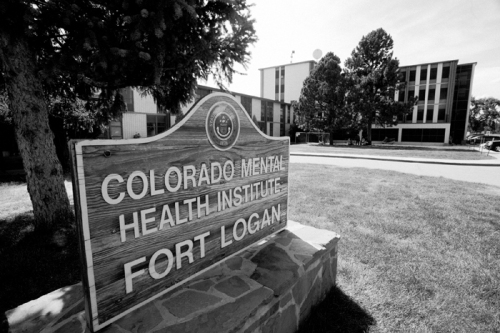
As the state budget gets carved up, Colorado residents, state workers, service providers and clients are all scrambling to figure out what the looming budget cuts mean for them. One area of concern is among the health and human services. These services are directly responsible for supporting homeless and poor people in the metro area and across the state, a portion of whom are considered disabled. Fort Logan Mental Health Center is among the organizations taking large cuts to balance the budget, and the cuts could mean as many as 200 people won’t get needed mental health services.

Fort Logan provides hospital services for the mentally ill. It serves patients with complex, serious and persistent mental illnesses. There are 153 inpatient beds and 20 residential beds. Each year about 650 patients are admitted, according to hospital admissions at Fort Logan. Cuts could mean that most of these patients would need to be redirected to other institutional facilities or not hospitalized at all.

Fort Logan Mental Health Institute is losing much of its resources due to state budget reform.  Beds and employee hours are being cut, leaving employees unhappy and many homeless people without a place to recuperate. Photo by ADRIAN DIUBALDO.

Read More
News Briefs: Federal government extends $30 million to staunch Section 8 bleeding

Published September 2009 Vol. 13 Issue 8

by Joanne Zuhl
additional reporting by Tim Covi

After housing authorities across the country reported massive shortfalls in funding, the federal government announced in August that it would provide an additional $30 million to people on Section 8 housing assistance.

The Department of Housing and Urban Development, or HUD, funds the Section 8 program through local housing authorities, like the Denver Housing Authority. People eligible for Section 8 housing enter into a lottery for vouchers. If selected, they then find an apartment with a participating landlord.

According to news reports and testimony before Congress, authorities across the country were saying they could no longer afford to provide housing assistance to tenants as the economic downturn overburdened their resources.

Read More
Feature: Catching Out

Published September 2009 Vol. 13 Issue 8

by Karolyn Tregembo
photography by Bill Ross

The city seems filled with vagrant kids, lounging on street corners, in parks, under bridges. I pass them on the bike trails and perched in front of the coffee house. Sometimes they ask for a dime or a bite to eat and sometimes I oblige. Some are just passing through, looking for a place to crash for the night. Others are faces I recognize and some I know.

Pony Boy sits on the sidewalk, playing his guitar, as much for his own enjoyment as for the passersby. At 17 years old, he is tall and baby faced, wearing a flannel and a mischievous grin. He is playing for enough change to get some coffee and maybe a sandwich. We have talked before, about how he never quite felt as though he fit in at home or school. As early as age 11 he found solace at punk shows and hanging out with like minds in coffee houses and the warehouse district. He says he has a place to stay right now, but finding a job is hard when you are young and don’t conform to social norms.

He likes to get out of the city sometimes and with no money in his pockets this is accomplished by jumping into an open boxcar. I am curious about the boxcar and he explains that he doesn’t really want to talk about hopping trains; he isn’t an expert and doesn’t want to give that impression. “There is a difference between living on the rails and catching a ride once in a while,” he says.

His friend, Banjo Fred, agrees, “I am still young and not yet fully experienced in the ways of the road, I have no right to pretend otherwise.” At 19, Fred is already a wanderer. He is good looking, quick-witted, and wise beyond his years. He tells me that he finds comfort and adventure in his travels, in going new places. I ask about a place to live, a job, possibly going to school. “There are things that get in the way of living frivolously, like sense and reason, both of which I cannot stand,” he says.

Huck Finn and Peter Pan with a modern twist. These two even hop trains. What could be more adventurous than jumping on a 2,000-ton piece of moving steel, heart pounding as it lurches and builds speed until it is carrying you at 60 miles per hour through vast, still undeveloped land. There is an obvious lack of sense and reason in stealing through dark train yards and thick brush beneath bridges to find the perfect spot to “catch out” (a term widely used to describe the act of catching a ride on a freight train). The excitement is in the unknown, in the anticipation of what lies ahead and often, in the very trains themselves.
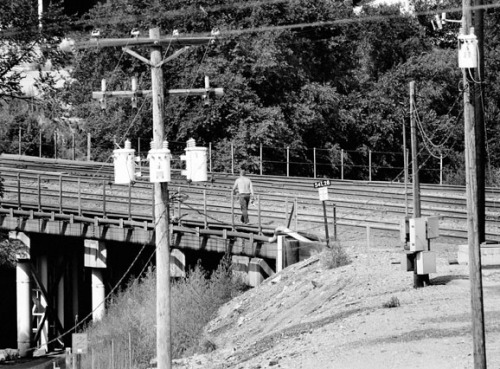
A youthful desire for adventure and hopping trains isn’t anything new. At the height of the Depression 250,000 teenagers were wandering across America, a large number riding the rails in the hopes of finding money, food and shelter. Train hopping is reminiscent of a time when the economic upheaval of the Great Depression and the dust bowls of the Midwest left hundreds of thousands of people out of work and homeless. A time when the railways were filled with men, women and children riding box cars across the country.

Read More