Art Feature: A six hour tour

Published September 2009 Vol. 13 Issue 8

by Ross Evertson

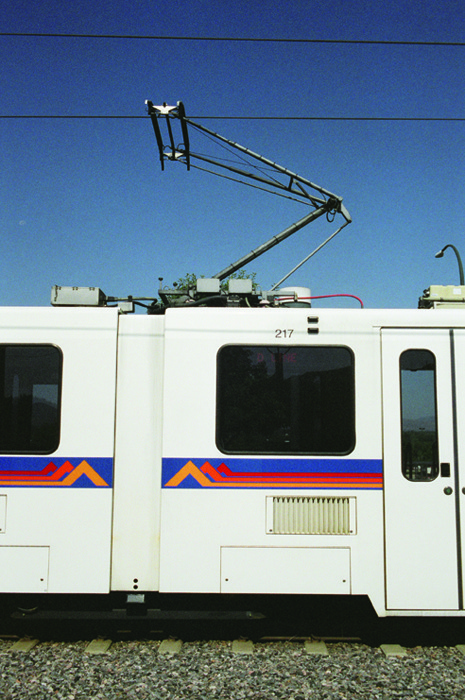
All but one stop. After going all the way from ‘Aspen Grove’ in Littleton, past the Rossonian in 5-Points, and all the way down to wherever-the-heck it is at the end of the F Line—I couldn’t bear to take the last leg over to 9-Mile. While the C/D Lines  briskly take you through the industrial corridor of Santa Fe Blvd, the F Line is slow, starting in a concrete valley west of I-25 and gradually turning into a tour of office park sprawl with bits of the prarie that said sprawl is consuming.

Read More
Personal Profile: Big Man in the Nut House - Big Al, an ex-Vietnam tank crewman, dishes out 400 lbs of wisdom on life in public housing.

Published August 2009 Vol. 13 Issue 7

text and photographs by Tom deMers

Tom deMers is a writer and former HUD property manager. He lives in Longmont, Colo. “Big Man in the Nut House” is a chapter taken from his unpublished book titled “Living in the HUD.” Names have been changed at the request of concerned parties.

Hobo Camp
Technically, Big Al was never homeless. He lived east of Boulder in a Tuff Shed. Times being what they are, Tuff Shed living may be a lifestyle more people want to look into. If so, Big Al is your guy. We spoke on the patio at Pineview, a public housing facility I managed. A cautionary note: talking to Big Al is like driving down an old country road, lots of twists and turns before it ultimately reaches its destination.   

“I stayed in the Tuff Shed while out at the hobo camp near the creek,” he tells me. Several years. “Digger lived there too. You know Digger?”  The name was familiar. “Yeah, he lived there. He came up on the list for Pineview, but they wouldn’t let him in. He had some real bad habits; they must have found out. Probably good. He used to shit on the floor and wipe his ass on newspaper and throw it in the corner. Hank loved everybody, but he finally asked Digger to leave.”

“Who was Hank?” I asked.

“He was a lawyer, but he was a hippy at heart. Great guy. He owned this land by the creek and loved to have us there with him. People came and went. Some guys had tents. Hank lived in a trailer,” said Al. “I had the Tuff Shed.”

The Tuff Shed sounded tough in the winter. Not for Big Al.

“Hey, it had a door. I ran the space heater, turned on the TV and sat in my old leather chair. It was great. Of course there was no running water. Unless you were Digger, you had to crap in the Porta-Potty. That was tough.”

“How come you left?” I asked.

“Had to. We all did. The county rousted us out and cleared the land. Some guy got tagged for shoplifting. The police came out looking for him and discovered us all. I mean, they went bush to bush chasing everybody out, except Hank. Lucky for me, just at that time, I was offered public housing at Pineview and two other places. I’d already turned down Section 8 because they were paying only $275 of my rent, which I’d have nothing left for food or doctors or anything. But now, two years later, my social security was turned on, and I had enough to make it work. Then, you showed me this place with its great view of the hills. I said, ‘This is it!’”
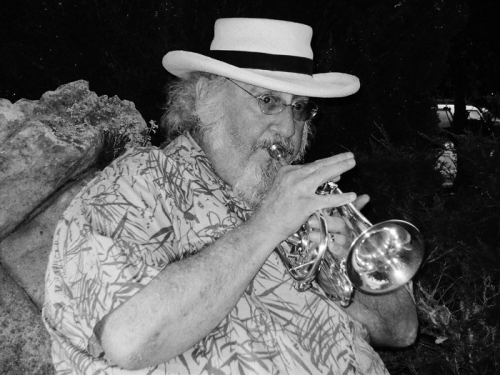
Big Al

Read More
Art Feature: Ravi Zupa

Published August 2009 Vol. 13 Issue 7

by Natalie Covert

Ravi Zupa can’t say his life has changed since the recent “world ending” recession. The Denver artist continues to live simply and make art daily.  He works independently and sets his own schedule, being sustained through art sales, video projects, and his recent Westword MasterMind Award for Video/Film/Multimedia. He moves easily from making multimedia compositions rich in illustration, to short films and music videos.

To know Ravi and see his self-portraits is to witness contradictions he uses throughout his artwork.  His self-portraits can suggest an intense character—bald with a straggly beard and dark piercing eyes; face-to-face, he reveals himself as quiet and humble—if not sweet.

Drawing from various religions and cultures, Zupa creates a myriad of mythological scenes featuring contrasts of character.   A Mayan God holds a pistol to his neck.  Armed soldiers bare the wings of an archangel.  A multi-armed Robot God sprouts from a lotus flower. 

By combining a wide assortment of icons, Zupa compels viewers to unveil the mystery behind his sometimes obscure connections.  Taking the opportunity to ask him some questions, we interviewed him about his work and inspirations. 

Read More
Feature: Aftershock - Addressing secondary trauma in a setting mindful of both clients and service providers

Published August 2009 Vol. 13 Issue 7

by Mandy Walker
photos by Adrian DiUbaldo

Barbara molfese sits in her small office at the Boulder Valley Women’s Health Center and remembers a client she counseled about an unintended pregnancy. The young woman, dressed in boys clothing, told Molfese about the incest and sexual assaults she’d experienced beginning when she was just five-years-old.

“You could just feel the pain sitting in a room with her,” said Molfese. “I felt heartbroken for her for the next couple of weeks. Sad, depressed. I just kept seeing her, picturing her in my mind.” Molfese, counseling supervisor and chaplain at the center, knew she was suffering from secondary trauma.

Like Molfese, Rene Brodeur, program director at the Boulder Shelter for the Homeless, can recall traumatic events, like attempted suicides or violence and the impact they’ve had on him. He also knows there are times when he can’t identify a single specific incident and yet has found himself experiencing secondary trauma.

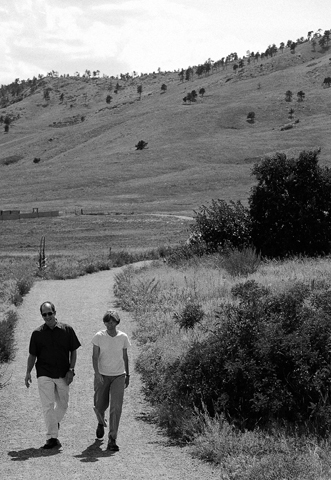
Rene Brodeur, left, and Janet Walker of the Boulder Shelter for the homeless have a meeting along the trails west of the shelter.

Read More
Feature: Wonder Valley

Published July 2009 Vol. 13 Issue 6

by William Hillyard
photos by Preston Drake-Hillyard

You might have passed through here, maybe.  Out for a drive with time on your hands, you might have taken the long-cut to the casinos of Laughlin, Nevada from the soulless sprawl of Los Angeles.


You’d have driven way beyond the outer reaches of suburbia, beyond its neglected fringe of citrus groves, past the outlet malls and the Indian casino, past remote Joshua Tree National Park and the Twentynine Palms Desert Combat Center, past the Next Services 100 Miles sign and any reason anybody really drives out this way.  You’d have blown through here at 60 miles an hour, probably, along a forgotten remnant of the old Route 66, its potholed and corrugated tarmac the only asphalt for miles.  If you were messing with your radio, fiddling with your phone, you might not have even noticed the grid of washboard tracks scraped from the sparse hardscrabble of greasewood shrubs in this nowhere corner of the Mojave Desert.  

Read More
Art Feature: Connection/ You+Ross Evertson

Published July 2009 Vol. 13 Issue 6

by Ross Evertson

I spent most of my time in college arguing. I went to art school, and despite the fact that I am an artist and photographer, it didn’t seem to agree with me. It was my nature then—and it still is, somewhat—to be disagreeable. I’ve been called argumentative and told that I obviously like to argue purely for the sake of it. Really though, I tend to play the devil’s advocate because it is typically more interesting and useful than simply agreeing with someone.

This project is the result of one of these arguments/discussions. Someone was waxing romantic about the connection between the photographer and his subject. This sort of mystical assumption is exactly the kind of thing that gets me excited to argue, but instead of engaging them I realized instantly what I would do instead. Five years later, I am finally working on it.

Read More
Feature: Busker Hustlin’

Published July 2009 Vol. 13 Issue 6

by Dwayne Pride

Street performers bring 16th street mall to life for summer.

Noon-lunch; lots of people sitting around and he is just dancing in the midst, showing off what he does. People are laughing and talking. Smooth jazz rolls off a trumpet somewhere down the street. Then he disappears into the alley. All I could see was the handle of his silver umbrella. He returned from the alley with some kind of ‘roller-type’ stage set up. People keep trying to take his picture and he keeps hiding under his umbrella.

Then—what a surprise! He has music! It’s plugged in somewhere up the alley. It’s a little more than the average street performer. The way he carries himself, Leroy Midyette, who goes by “Jambot” on the mall, seems to be a mime. His bags are full of props. He starts putting on more make-up while “Thriller” plays from his boom-box. His face looks like a mask or statue.

Jambot entertains pedestrians on the 16th Street Mall, photo by Vinnie Vertigo.

Some lady is walking by and he trots along beside her as she keeps walking. He finally puts his bucket out for tips and gets up on the stage. Overcast skies have turned to sun. Out comes the sign, “Photo or Video $5. Money Make Me Move.”

Read More