
Published July 2009 Vol. 13 Issue 6
text & photographs by D. Giles Clasen
After a three-year battle waged between Denver taxi companies, the Public Utilities Commission finally approved the creation of Union Taxi.
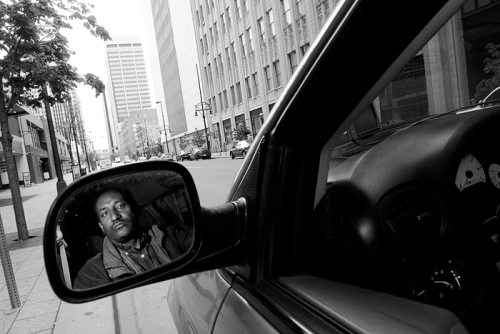
Ali Ahmed waits idle, fourth in line at a taxi stand in downtown Denver. He worries about how his cab looks. He takes a stocking cap from a cubby next to the driver side seat and cleans the side mirror before getting out of the car and walking to his friends, also waiting for fares, to talk.
The small group exchanges handshakes and hellos before their conversation goes one place—to Ahmed’s worn but newly painted orange taxi.
Ahmed is fourth in line today and will wait for his turn to give someone a ride. But he is excited to wait; he has been waiting through a 3-year battle for the right to open a new cab company with 262 other taxi drivers.
Published: April 2009 Vol. 13 Issue 3
photography & text by Ross Evertson
 Earthship designed and built by Joe Callahan of Boulder, Colorado. Photos by Ross Evertson.
I was raised in the carpet and drywall world of suburban Denver. The homes of my friends all looked and felt so similar to my own, each one was like a visit to a parallel universe (some of them even shared the exact same floor plan, and everyone decorated the same way—the primary difference was the odor, if the parents smoked, or if there was a baby). There was something comforting to the sameness at that age, but as I got older that sameness became almost depressing and it was rare for me to ever find that level of comfort in the home of anyone else, friend or stranger.
It was particularly bizarre, then, when I first stepped into an earthship. It did not look like any home I had ever been in before. Beneath the iconic south-facing floor to ceiling windows is an indoor garden, fed by greywater from the sinks and shower. The soft forms of the structure flow all around. As organic as the stucco walls feel, they are covering a traditional earthship building material—used automobile tires filled with tightly compacted dirt.
Published: April 2009 Vol. 13 Issue 3
photography and text by D. Glies Clasen
EDAR photographs by Julie Yurth Himot
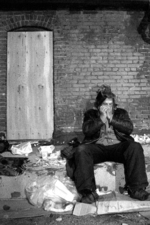 Mark Hedrick plays his harmonica trying to relax after a long day on the streets.Each night around 9 or 10, the traffic slows, and most weeknights, the city falls into a slumber.
That’s about the time the homeless men and women in Denver begin moving toward their campsites.
They set up their bivouacs, temporary encampments under little or no shelter.
The lucky ones might have a tent or roof.
Published February 2009 Vol. 13 Issue 1
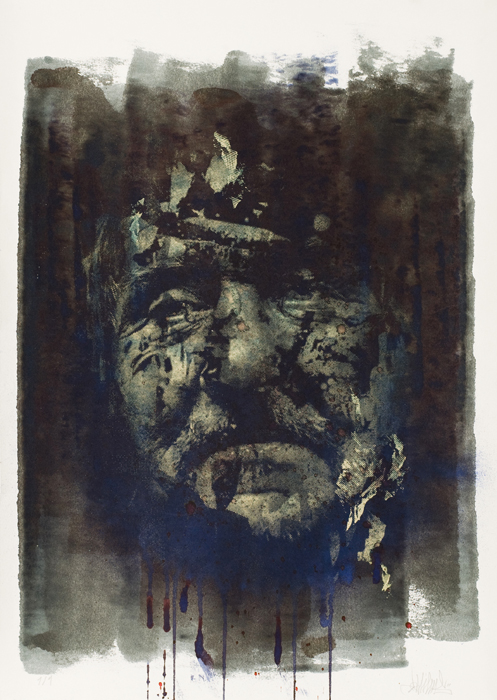
From humble beginnings as pure vandalism, street art has transformed into an internationally embraced art form. Artists Shepard Fairey, Banksy and others have crossed over into the mainstream—becoming household names and very, very rich.
In November, 2008 Megafon, a street magazine in Bergen, Norway ran an art auction with works of famous and up-coming street artists from around the world. They gathered artwork from about 40 artists and had a one night only exhibition in Bergen. All the artwork was sold, and they raised NOK 175,000 (about $26,000 USD).
Published February 2009 Vol. 13 Issue 1
by William Hillyard
illustration by Kenn Penn
photographs by Preston Drake-Hillyard
Patti Church eased her car around the corner and into the swirling crowd, stopping near the piles of clothing spilling from ripped plastic trash bags. Flimsy folding tables stood waiting for her. As Patti opened her car door, she became the center of the crowd; volunteers looked to her for direction, asking questions—where do you want this, who is to do that? One man, his face bristling with a silver stubble, opened Patti’s trunk and began unloading paper grocery bags to the folding tables, others grabbed cases of soda, boxes of cakes, plastic trays of salads, until the wobbly tables were top-heavy with food. Another, Francisco, grabbed a box from the car’s back seat, then stood shuffling from foot to foot, looking for an opening to the tables. As Patti approached, about fifty men, their weathered hands warmed in worn pockets, congealed into a tight group.
Rafael paced around the rear of the crowd, his sun-browned face taut with worry. He could see Patti, there behind the tables, her arms pointing, gesturing, her blond bob framing her soft face. The hiss of the nearby highway overpass drowned her words. Rafael hadn’t made it back to his camp the night before, and when he returned in the morning he found that it had burned; southern California winter had arrived after a long, warm autumn, bringing an icy rain and night-time temperatures near freezing. The others, retreating from the cold and the rain, had built their fire too close to the shelter. It caught fire and burned everything. Rafael returned to find that he possessed, literally, only the clothes on his back. He needed Patti’s help. A man, his arms stretched around a polyester comforter, wiggled in behind Rafael and over his shoulder shouted, “Who’s the one who lost his camp last night?” Rafael looked around with a start. “Who’s the one who lost his camp?” Other men gestured at Rafael. “You the one?” Rafael nodded as the man pushed the bundle into his arms, his fingers barely clasping around it. Patti had come through again.
“These men live simply,” Patti says of them, “They send most of what they earn home to their families in Mexico.” In the past, she fed about 50 men here each night, but the number has swollen recently to 60 or more. The men she and her group feed here on this corner spend their days along busy, nearby Doheny Park Road standing facing traffic, waiting for work. This street has been a day labor site for two decades and has seen anti-immigration protests in recent years by groups like the Minutemen. In fact, a group of Minutemen held a “flag rally” here in January, their first demonstration of 2009. “Nothing has taken place,” said one Minuteman, videotaping his group’s protest. “Our purpose, so far, has been successful; there have been zero hires. No body is picking up the illegal aliens,” he continued into his camera. They came to disrupt the hiring of day laborers, but the economy had already done their job for them.
It is not that day laborers like Rafael choose to live outdoors; it’s just that, as the U.S. economy slows, the work doesn’t come. The current day labor trend has grown up around the boom in construction and the collapse in the industry has affected day laborers disproportionately. California alone has lost more than 200,000 construction jobs since the peak two years ago according to the U.S. Bureau of Labor Statistics. Construction work in Southern California, like elsewhere in the country, has all but disappeared.

Published February 2009 Vol. 13 Issue 1
by Hank Lacey
The nation’s economy is sinking deeper into the worst recession in decades. More and more Coloradans are suffering stagnant wages, loss of health insurance, unemployment and even the loss of their home.
Driven by deteriorating economic conditions, the Office of Legislative Council says Colorado is facing a budget shortfall of more than $600 million this year and about $300 million for the 2009 fiscal year, which starts July 1. The consequences are likely to be big cuts to many government services that people all over the state, but especially in the Denver urban area, take for granted.
The state has been down this road before. Between 2001 and 2003 Colorado faced budget shortfalls that eventually reached about $850 million in FY 2003 and about $900 million in FY 2004. The General Assembly balanced the budget, as the state constitution compels it to do, by imposing across-the-board cuts to state agencies and by using a variety of accounting measures to move expenditures into future years.
This time a solution might not be found so easily. Gov. Bill Ritter said as much during his annual State of the State speech on January 8.