
The Psychology of Hate

By Patrick Naylis

Illustration by Rob Shetterly (www.americanswhotellthetruth.org)

Derrick Jensen is an American author and environmental activist. In 2008, he won the Hoffer Award and was named one of Utne Reader’s “50 Visionaries Who Are Changing Your World.” His 2003 book, “The Culture of Make Believe,” was a finalist for the Lukas Prize Project Award for Exceptional Works of Nonfiction, sponsored by the Columbia University Graduate School of Journalism and the Nieman Foundation at Harvard. “The Culture of Make Believe” explored issues of hate and violence in our culture.

As a launching point for our thematic issue this month, Patrick Naylis talked with Jensen by phone about the issue of hate. Whether you agree with him or not, Jensen offers a thought provoking interview about some of the most controversial issues in American culture. He’s not shy to state an opinion, and we hope you’re not as well. Our hope is to generate a discussion about these issues. Share your thoughts online at www.denvervoice.org, or submit a letter to the editor at editor@denvervoice.org. Comments and feedback, both supportive and dissenting, will be published in the May issue of the Denver VOICE.

 

Read More
Respect My Pronouns

By Patrick Naylis

Toby loves waffles. His nickname is Waffle. “I ate 336 waffles over three days while my dad was in the hospital,” said Toby, explaining how he acquired the nickname. “Chocolate chip are my favorite,” he said with a bright smile. He loves waffles so much, his mom is bringing back a waffle iron from a trip to California.

Toby attends Aurora Central as a freshman. He and his family recently located from Manitou Springs. “I actually like getting up and going to school. I look forward to it. And on occasion I’m early so I can hang out with my friends,” said Toby of his new school.

Toby didn’t always enjoy school. In fact, he found school in Manitou Springs to be a de-valuing experience. “We had to transfer out of the old school because of LGBT bullying,” said Toby.

LGBT stands for Lesbian, Gay, Bisexual and Transgender, and for this group of people, bullying in and out of schools is a big problem. “It’s a problem for all students,” said Erin Yourtz, Colorado One safe schools coordinator. However, according to a study by the Gay, Lesbian and Straight Education Network (GLSEN) bullying is the norm for LGBT students in their day-to-day experiences at school.

Read More
Elephant Talk

By Kristin Pazulski

Photography by Adrian DiUbaldo

At the request of a friend, two years ago Randy Harris visited a church food pantry in Denver’s Villa Park neighborhood, just west of Federal and south of Colfax. A few loaves of bread and canned goods sat on the shelves. A girl came to the church with her father. She was irritable and grumpy; the reason, her father explained, was she hadn’t eaten in three days. They took their bread and cans of vegetables and went home.

Harris was horrified not only that she hadn’t eaten in three days, but also by the quality of the food they left with. When Harris asked the church why there was a lack of fresh food, he learned that they didn’t have the money to buy much more and donations from food drives are focused on canned and boxed non-perishables.

 Harris, a former corporate and government research consultant, started looking at Colorado’s current food pantry services. What he found, he says, is an unorganized business model, with scattered pantries full of well-intentioned people, but not much food. In his mind, why not pool the services?

“There’s plenty of food. We’re trying to parse it out to way too many places,” Harris said.


Read More
A Month of Photography with Mark Sink

By Anne Arden McDonaldInterview & Text by Travis Egedy

Mark Sink is kind of a big deal. I have known him for years, and outside of being a good friend, he has always been a supporter and champion of the underground art community. As a young emerging artist in a city that sometimes chooses not to care about such things, Mark has always been there getting people to pay attention. He is actually one of the reasons that the term “Denver art community” is even something to be written about. He is directly responsible for Denver’s Museum of Contemporary Art, and is basically behind or involved somehow in most of our cities coolest and more progressive art happenings, most notably the “Month of Photography,” taking place throughout Denver this month and into April.

During the Month of Photography (or MOP), over one hundred galleries, concert venues, warehouses and museum spaces will be filled with photographs from hundreds of artists both from Denver and all over the world. The idea is to create dialogue between the city and the art scene and to celebrate the medium he loves, all the while allowing scores of relatively unknown photographers a chance to have their work recognized and seen. This can only be positive, and Mark speaks of his wish that MOP will be able to transform Denver’s urban landscape into a canvas that can be beautified.

I spoke with Mark in his kitchen over some tea about MOP and the beautification of Denver.

Read More
Food For Thought


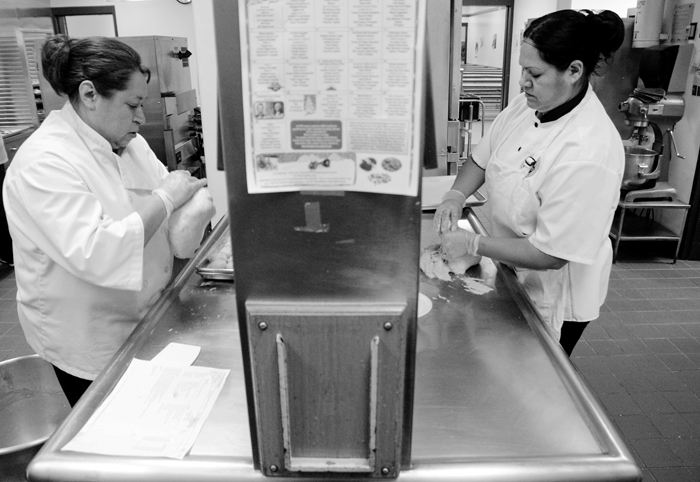
Cooks at Centennial Elementary prepare dough for oatmeal honey rolls they serve at lunch.

By Kristin Pazulski

Photography by Adrian DiUbaldo

Leo Lesh’s food service enterprise includes 156 locations and serves about 38,700 lunches per day. He’s not open on the weekends, charges just $1.40 per meal (if customers pay full price, though many do not) and he gets just $2.72 per meal beyond that charge to cover all his food, labor and operations costs.

Most would say it’s an impossible feat. A dying business, one that won’t make it, but this is no ordinary food service business. And Lesh, executive director of Denver Public Schools Food and Nutrition Services, has not only managed to keep DPS’s school lunch program chugging along, he’s slowly improving the nutritional side of a traditionally unhealthy meal.

And just in time too. While Lesh has been looking for ways to reduce sodium in cheese and fat in milk, the U.S. Department of Agriculture has been developing guidelines that will require him to do just that.

Read More
Tough Love

By Tom deMers


Home was the third floor of a house with a balcony out front. It was the top floor a few blocks from one of Denver’s busiest streets. It was secure. Three locked doors separated the apartment from the street below. But it wasn’t safe. Renee had keys to none of those doors. She was allowed out once a week when they went to Wal-Mart. She wore oversized sunglasses to hide the bruises and always walked behind him. He pointed to things, she put them in the cart. If the damage to her face wasn’t too bad, they stopped for lunch. He sat between her and the exit.


Read More
Campaign Questions

By Tim Covi

With the Mayoral elections around the corner, we wanted to ask candidates for their opinions on an often under-discussed topic in municipal elections: homelessness. Over the past few years, Denver’s homeless population has sky rocketed, going from 3,954 people in 2007 to 6,656 in 2009, a 68 percent increase. Service providers estimate that it has continued to rise through 2010, something we won’t know clearly until the next Point in Time survey is released later this year.

While not completely solving the problem, Denver’s Road Home—the city’s 10-year plan to end homelessness—has been instrumental in creating more housing opportunities and bringing much needed attention and resources to the homeless community. Mayor Hickenlooper was a pivotal part of garnering support and funding for the plan.

We asked every candidate two questions to see how they’ll approach the issue of homelessness. Twelve of the 14 candidates answered by press time. Additional responses might become available on our website at: www.denvervoice.org

Read More
Meet Metech

A worker at Metech breaks down electronics into recyclable parts for further processingBy Patrick Naylis

Photography by Ross Evertson

Semi-trucks dominate the traffic in this part of Denver’s industrialized north side.  Inside a dusty100,000 square foot warehouse, a line of around 20 workers disassembles electronic goods.  They demolish electronic products ranging from 50’s era bakelite TV consoles to modern day hi-res flat screen monitors.  Behind them, hi-los scoot across the concrete floor carrying bins of sorted electronic components to waiting semi-trailers. 

This is Metech Recycling, an e-waste recycler that differs from other recyclers in the area.  Conscientious consumers brought their electronic refuse to Metech because they know it will be recycled responsibly.  They are certain it won’t be discarded in a municipal landfill or dumped on a poor nation in, say, West Africa, causing polluted air, aquifers, and soil.

Metech provides this guarantee as the basis of their business, and with the growth in disposable commodities causing environmental concern, it’s an important guarantee.

Americans buy a lot of new technology.  According to the Consumer Electronics Association, we spent $180 billion on electronic gadgets last year.  They seem to make our lives easier, save time, and offer more ways to communicate.  Consequently, Americans also trash a lot of technology: according to the Environmental Protection Agency (EPA), we produced 3.1 million tons of e-waste in 2008.

Read More